


Sinus problems are extremely common in India. Whether it’s constant nasal congestion, facial pain, headaches that never end or difficulty breathing, many people suffer for years without knowing the real cause. Most patients rely on steam, nasal drops or antibiotics repeatedly, but the relief is often temporary. Hmm, yes, it’s frustrating when symptoms keep returning again and again.
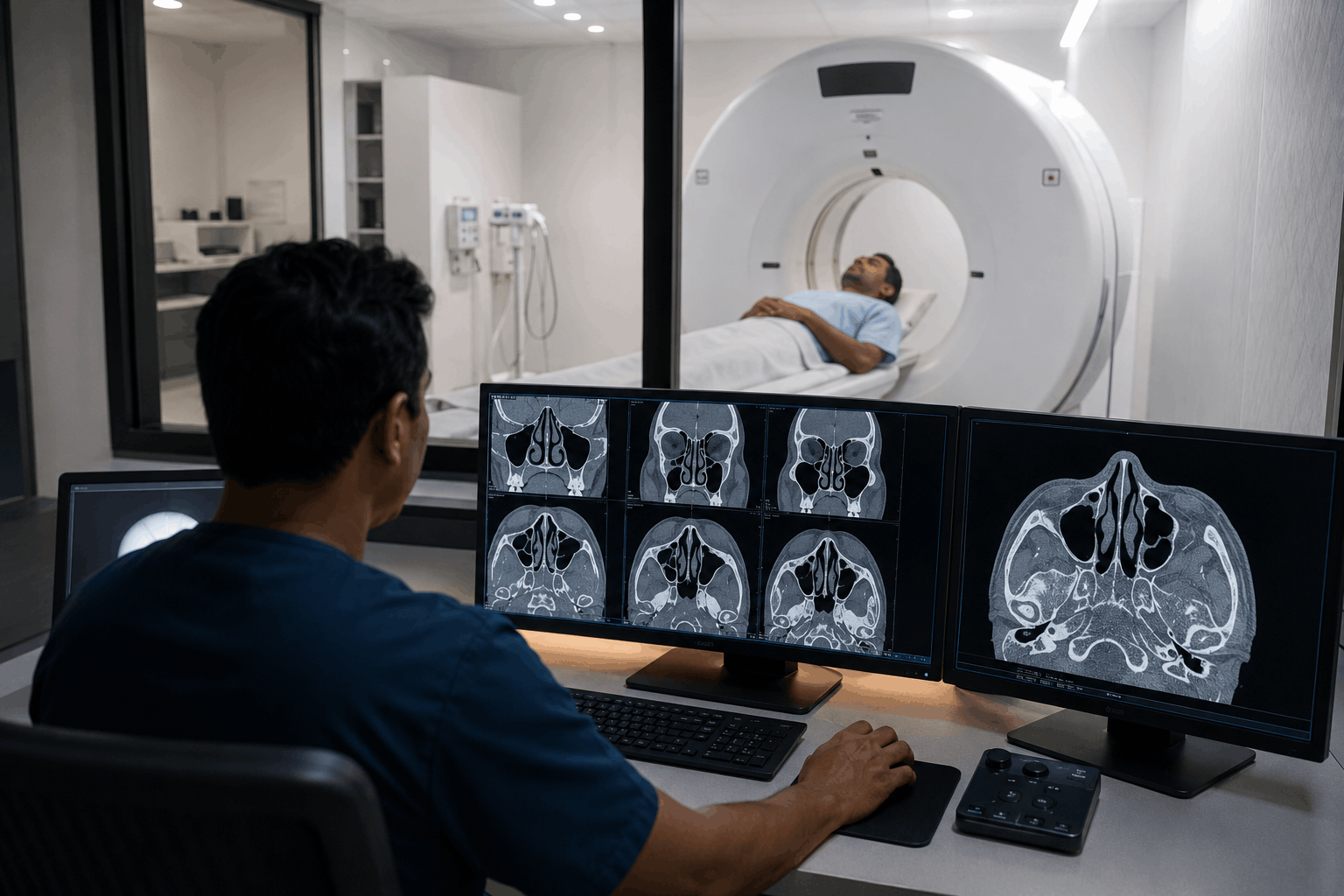
This is where CT Scan of the Paranasal Sinuses becomes a game changer. It displays a clear, highly detailed view of all the sinus cavities, nasal passages, and surrounding structures, giving doctors an easy way to identify what’s actually causing the problem. For someone who has struggled with long-term sinus problems, a CT scan provides perhaps the most accurate way to get real answers.
Let’s look a little closer at how a CT scan helps in the diagnosis of common sinus issues and why it may be right for you.
The symptoms of the sinus can be very deceiving. A blocked nose might just be a minor cold, yet it could be a structure problem. A headache may resemble stress, but it may be a sinus infection; and difficulty breathing may seem insignificant yet may be a swelling or obstruction.
The CT scan revealed:
These details are not clearly captured by a routine X-ray. CT scanning, on the other hand, provides doctors with a high-resolution picture of the sinuses in a complete 360 degree view, which will speed along with the accurate diagnosis of problems.
Here are some of the most common sinus conditions that can easily be diagnosed with a CT scan:
Chronic sinusitis is one of the most common sinus conditions in the country. Chronic sinusitis occurs when the sinuses have been inflamed for over 12 weeks, despite having been treated.
CT scans can detect:
Patients sometimes will say, “Hmm… I keep taking antibiotics and the sinus just keeps coming back.” A CT scan provides information on why the inflammation isn’t getting better – then they can plan effective longer-term treatment.
A deviated septum means the thin wall in between the nostrils is crooked. This may prevent airflow and cause repeated sinus infections.
Many patients with a DNS have breathlessness, snoring, and sinus headaches without realizing there was something structurally wrong with their nasal septum.
Nasal polyps are benign, soft tissue growths that develop because of chronic inflammation.
CT can show the:
Polyps are common among people with allergies, asthma, or chronic sinusitis.
In severe sinus infections, CT scans allow doctors to detect:
This is particularly important in the presence of persistent symptoms despite medication.
Though less common than viral or bacterial sinusitis, fungal infections are serious. They are diagnosed via CT scans.
They help detect:
Fungal sinusitis is an emergency, and early detection by CT can avoid complications.
Though relatively rare, tumors can also arise in the sinuses. These may be either benign or malignant.
CT scan can reveal:
The earlier the diagnosis, the better the treatment.
Some sinus-related issues are not due to infections, but due to narrowed or blocked drainage pathways.
CT scan shows:
Fixing the drainage in the patient usually provides long-term relief to chronic patients.

Some people are simply born with anatomical variations in the shape of their sinus cavities. These variations may not cause issues for many years until suddenly, as they are older, they begin to create symptoms.
CT scan shows:
This information is very helpful to ENT doctors in developing precise treatment plans.
A sinus CT scan is straightforward:
The whole thing only takes 3 to 5 minutes, which is very convenient for patients of any age.
Most patients seek diagnostic centers that guarantee them accuracy, comfort, and reliability. This is where Aarna Diagnostic Centre stands out from the other diagnostic centers with its use of technology combined with compassionate care.
Advanced CT Technology
High-resolution scanners produce crisp images of the sinuses, nasal cavity, and skull structures.
Low Radiation Dose
Special dose-saving techniques guarantee safety without compromising image clarity.
Experienced Radiologists
Sinus CT scan interpretations are specialized. Aarna’s radiologists provide accurate and comprehensive interpretations.
Fast Reporting
It ensures fast delivery of detailed reports necessary for ENT specialists to plan appropriate treatment.
Comfort and Patient Care
Our intent is to assist patients gently from the moment they arrive, particularly children and elderly patients who might be apprehensive.
Commitment to Preventive Healthcare
The center strongly advocates for early detection and timely screening to keep the families healthy and away from complications.
A CT scan gives clarity when symptoms are confusing.
Sinus issues do affect day-to-day life quite dramatically. When symptoms persist despite medicines, it is important not to ignore them. The sinus CT scan gives an overview of what really is happening inside your sinus cavities, aiding the doctor to make a correct diagnosis and preventing further complications in the course of the treatment. Aarna Diagnostics combines modern CT technology with experienced radiologists and patient-centered care to ensure clarity and confidence for each person. If sinus problems have been troubling you or a loved one, getting a CT scan might be the step that finally brings relief.
Convenient Tests right at your Doorstep!


86, Kargi – Patel Nagar Bypass, near Palm City, Adarsh Vihar, Brahmanwala, Dehradun, Uttarakhand 248001
1, Maharani Bagh Lane, Ballupur Chowk, Ashirwad Enclave, Ballupur, Dehradun, Uttarakhand 248001
1, Chakrata Rd, near Rohan Motors, Selakui, Central Hope Town, Uttarakhand 248011
F-7, Haridwar Road Nehru Colony Dehradun, Uttarakhand 248001 India
Leave a Comment