

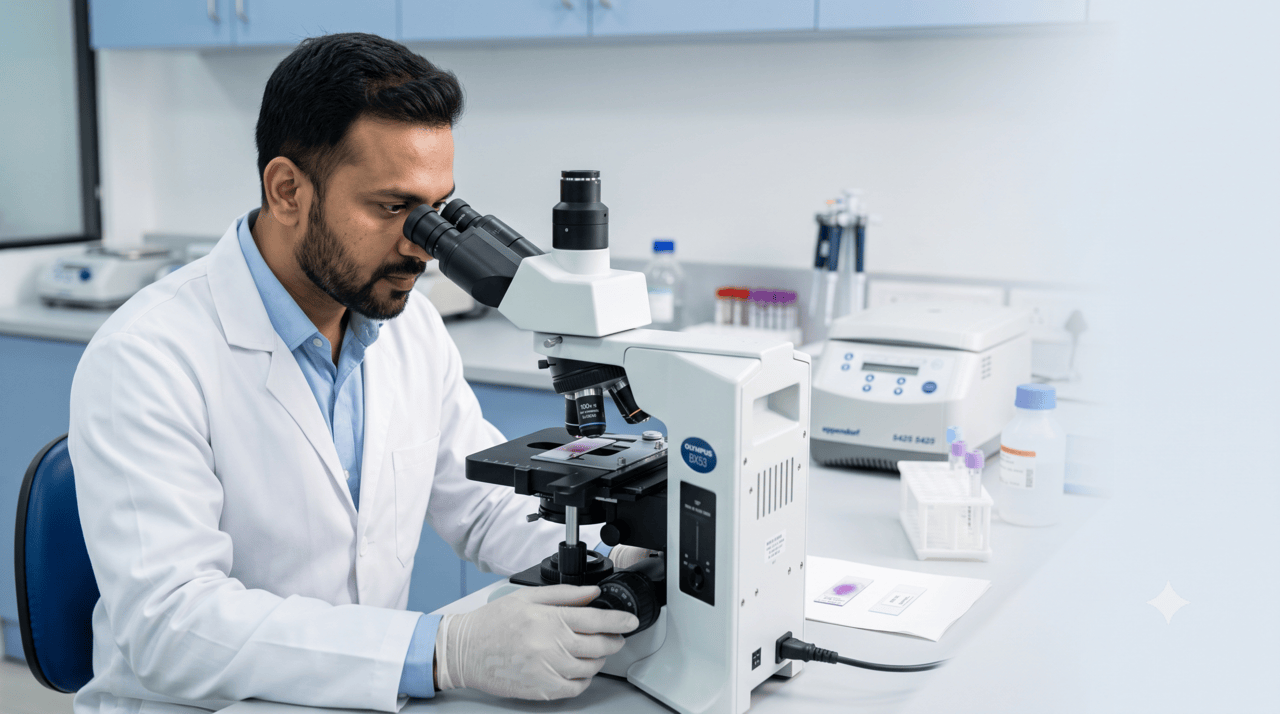
The blood sample is just a fraction of whole blood. The blood smear test provides blood cells’ characteristics that wouldn’t be visible with a normal routine blood test. A blood smear test allows doctors to assess the cells and achieve an understanding of their size, shape, quantity, and maturity.
Peripheral Blood Smear Test implies laboratory testing which involves a blood sample taken with a special instrument and put on a glass slide. The blood sample is stained to highlight different blood components. A lab technician looks at the sample through a microscope.
The blood smear test assesses three components of blood: red blood cells, white blood cells, and platelets. Changes in their appearance can provide clues about anaemia, infections, blood disorders and other medical conditions.
In case any abnormality in the CBC test results is detected, a peripheral blood smear test is usually advised by the doctor. A CBC determines the count and characteristics of particular blood cells, whereas a blood smear gives an opportunity to visualize blood cells under a microscope.
In addition, the doctor may request a peripheral blood smear test if the patient experiences fatigue, weakness, fever, bruises, and recurrent diseases, among other unpleasant symptoms.
Red blood cells carry oxygen throughout the body. During a peripheral smear examination, their size, shape, colour and overall appearance can be assessed.
Changes in red blood cell morphology may provide useful clues about different forms of anaemia and other blood conditions. For example, the smear may reveal unusually small or large cells, variation in cell size, target cells, spherical cells or fragmented red blood cells. However, these findings need to be interpreted together with other blood tests and the patient’s clinical history.
White blood cells form an important part of the body’s immune system. A blood smear can help assess the different types of white blood cells and identify unusual or immature cells.
Changes in white blood cells may occur with infections, inflammation, certain immune conditions and blood disorders. In some circumstances, abnormal cells seen on a smear may lead a doctor to investigate conditions such as leukaemia or other bone marrow disorders.
Importantly, an abnormal smear does not by itself confirm a serious disease. Additional testing is often necessary.
Platelets help blood clot when an injury occurs. A peripheral smear allows their approximate number, size and appearance to be assessed. It can also help determine whether an apparently low platelet count on an automated test might be related to platelet clumping rather than a true reduction.

Blood smears can provide helpful information related to various diseases. Changes in white blood cell levels can indicate how well the immune system is performing.
Peripheral blood smears may also be useful in identifying some parasites that may enter the organism via the blood. Malaria is one of the important examples of the disease that can be diagnosed using peripheral blood smears.
Doctor will choose a specific test in accordance with the suspected problem that the patient has. As a result, there may be additional tests done together with peripheral blood smears.
The process is really simple. The medical professional takes a small sample of blood which is usually collected from a vein in the arm. The sample gets to the laboratory where it is spread into a thin layer on a glass slide.
Usually, no special preparation or fasting is required specifically for a peripheral blood smear. If other blood tests are being performed at the same time, however, patients should follow any preparation instructions given for those tests.
A CBC and peripheral blood smear provide different but complementary information.
A CBC primarily measures quantities such as red blood cells, white blood cells, haemoglobin and platelets. A peripheral blood smear provides a visual examination of these cells.
For this reason, doctors may request a smear after an abnormal CBC to understand the finding in greater detail.
A peripheral blood smear should not be interpreted in isolation. An abnormal result does not automatically mean a person has a serious disease. Findings need to be looked at together with symptoms, patient history, CBC findings and other tests where necessary.
Here at Aarna Diagnostic Centre, peripheral blood smear testing is included in laboratory tests, when clinically indicated. Patients need to communicate their test results to their doctor, who will put the results in the context of other information about patient’s health.
No. CBC reports blood cells count and some other parameters while PBC involves looking at the cells under the microscope.
Not necessarily; no special preparation is required for this test except for certain tests which need fasting.
It does provide clues regarding anaemia by showing differences in size, shape and morphology of the red blood cells.
It may show abnormal or immature white blood cells making the doctor suspicious of leukaemia but it cannot provide definitive diagnosis.
The procedure mainly involves collecting a blood sample, through which patients experience a sharp pinching sensation for a moment, and bruises may appear afterwards.
Convenient Tests right at your Doorstep!


86, Kargi – Patel Nagar Bypass, near Palm City, Adarsh Vihar, Brahmanwala, Dehradun, Uttarakhand 248001
1, Maharani Bagh Lane, Ballupur Chowk, Ashirwad Enclave, Ballupur, Dehradun, Uttarakhand 248001
1, Chakrata Rd, near Rohan Motors, Selakui, Central Hope Town, Uttarakhand 248011
F-7, Haridwar Road Nehru Colony Dehradun, Uttarakhand 248001 India
Leave a Comment