

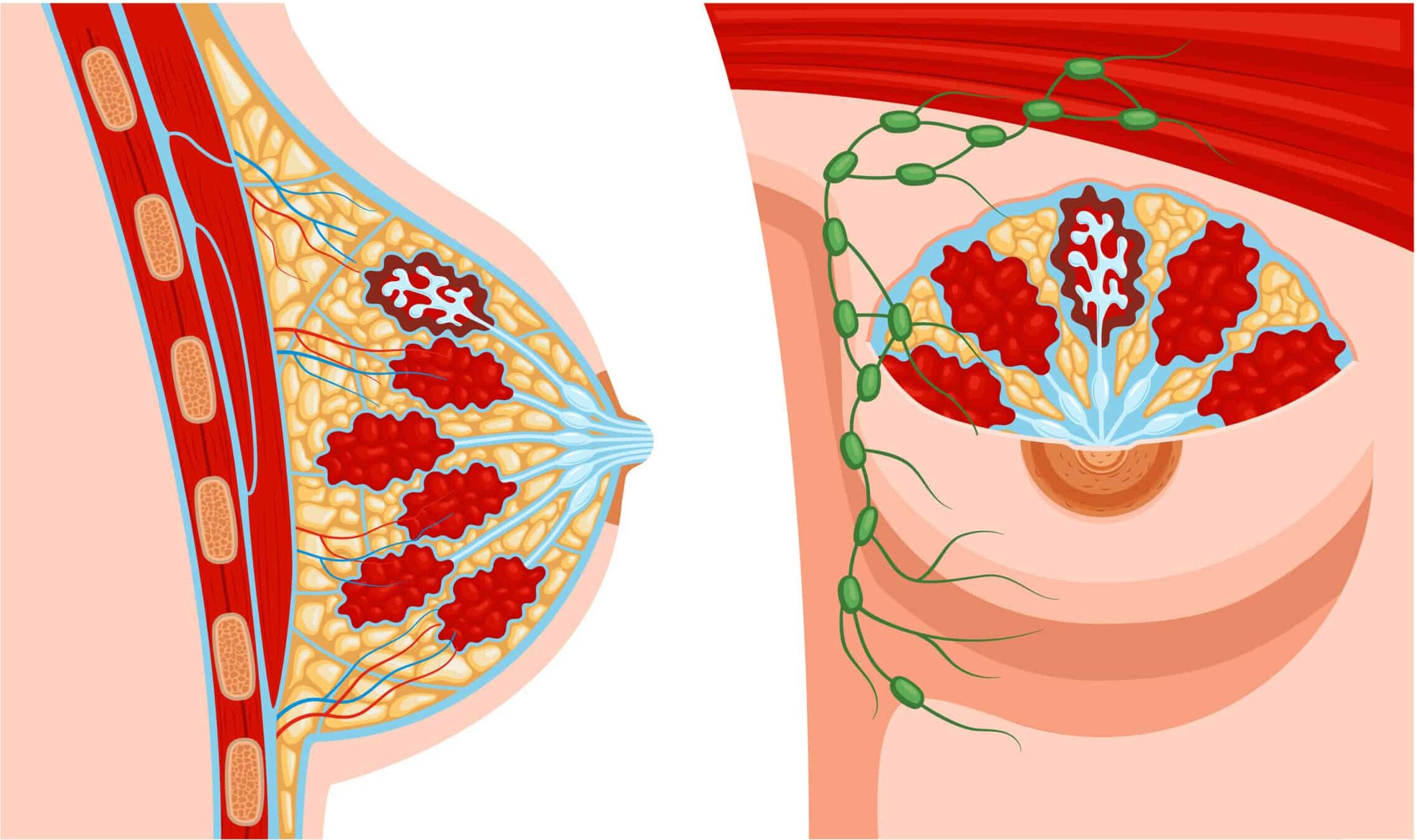
Breast health has become an increasing concern for women around the world, particularly with the rise in both breast cancer and benign breast conditions. For the early detection of the abnormalities in the breast tissue, mammography is used and this technique is most reliable and commonly endorsed imaging method. In this technique low doses of X-rays are used to assess the breast tissue and detect changes that might be not be detectable in the physical examination.
Identifying changes in breast tissue at early stages has helped save numerous lives. Mammography has played a vital role here. This tool is very crucial in the management of women’s health, it can be used for both screening or diagnostic purposes.
Let’s discuss the most prevalent medical conditions that mammography aids in diagnosing, the significance of early screening, and how women from various age groups benefit from it.
1. Breast cancer (Invasive and Non Invasive)
Invasive Breast Cancer
The invasive breast cancers are more dangers they extend beyond the ducts or lobules into the surrounding of the bfreast tissue. A mammogram can spot changes like irregular masses, spiculated lesions, skin thickening or change sin the breast structure. If the breast cancers are detected at a early stage the treatment options are wide like surgery, radiation, chemotherapy, or the hormonal therapy.
Ductal Carcinoma In Situ (DCIS)
DCIS is referred to as a non-invasive cancer because it stays within the milk ducts. DCIS is often detected through mammography when microcalcifications are noted on the imaging, seen as white spots on a mammogram. Recognizing DCIS early is essential in order to help prevent it from progressing to invasive cancer. The general recommendation for microscopic calcifications is generally due to the concern of developing into an invasive cancer.
2. Fibroadenomas
Fibroadenomas are benign (non-cancerous) breast tumors that are often identified in women ages 15 to 35. They typically appear smooth and well-defined on mammography, and do not invade surrounding tissue. An ultrasound may then be obtained for better evaluation. These lumps are typically benign and can often be treated conservatively.
3. Breast Cysts
Breast cysts are sacks containing fluid, which may exist alone or in a cluster, are often found in women aged 30-50 years. Cysts can appear round or oval and borders are sharply demarcated. An ultrasound can be obtained to differentiate simple versus complex cysts.
4. Calcifications
Calcifications are small mineral deposits that can be seen on mammograms, and are defined as:
Microcalcifications
These calcifications are aggregated in a group and are small in size, and can sometimes indicate precancerous changes or DCIS.
Macrocalcifications
These are larger and more irregular deposits that are usually benign and common in women over the age of 50. Radiologists will assess their shape and distribution to help determine if further evaluation is needed.
5. Fat Necrosis
Fat necrosis is a benign condition that arises due to a prior surgery, trauma, or radiation therapy that has damaged breast fat tissue. On mammograms, fat necrosis can be in the form of irregular masses or calcified areas. Fat necrosis can mimic cancer, which may require a biopsy to confirm.

6. Mastitis and Infections of the Breast
Mammography is useful for identifying inflammatory changes, which include localized swelling, redness of breast tissue, and breast structure distortion. For example, mastitis can mimic inflammatory breast cancer, especially in breastfeeding women, so breast imaging is important.
7. Gynecomastia in Men
Although breast imaging is most often associated with female patients, mammography can help diagnose breast enlargement in men and gynecomastia. Gynecomastia can be caused by hormonal imbalance, medications, obesity, or liver disease. Mammography aids in distinguishing gynecomastia from male breast cancer.
8. Intraductal Papilloma
Intraductal papillomas are benign tumors that occur inside the breast ducts. Intraductal papillomas can cause nipple discharge or bleeding. Mammography may reveal small nodules or duct changes in breast tissue, especially in women with discharge that is coming from the nipple. If intraductal papillomas are suspected, ultrasound or ductography may be performed.
9. Lobular Carcinoma In Situ (LCIS)
Although LCIS is not classified as cancer, it constitutes a risk factor for breast cancer. Changes detected in a mammogram, possibly indicating LCIS, may be subtle observable changes from the normal tissue or may even be detected incidentally when biopsies are performed for other abnormalities. Most women with an identified LCIS will require ongoing screening.
10. Density Related Conditions
The mammogram will also help note the density of breast tissue. Dense breast tissue contains much more glandular tissue and less fat than non-dense tissue. A dense mammogram can prove difficult in the detection of tumors and mammograms will often be used to identify:
- Hidden tumors
- Dense nodules
- Microcalcifications
Your provider may recommend digital mammography or tomosynthesis (3-dimensional imaging) for more accurate screenings.
11. Paget’s Disease of the Breast
Paget’s disease of the breast is a rare form of breast cancer that will often manifest solely in the nipple. Some symptoms may include the skin of the nipple appearing red or crusted, having discharge from the nipple, or if the nipple becomes thickened or scaley. A mammogram will likely identify associated ductal carcinoma in situ (DCIS) or invasive cancer.
12. Monitoring after Surgery and Recurrent Disease
In the case of women who have had breast surgery, such as lumpectomy or mastectomy, mammography generally contributes to 3 components in monitoring or treatment of screening:
- To detect recurrence, monitor the natural scar tissue, and identify new developments (percent of missed malignancies).
When should I get a mammogram?
- Recommendations for screening mammograms differ somewhat among professional organizations; however, generally:
- Women age 40 and older should have screening mammograms every 1 to 2 years.
- Women at high risk or with a family history (ex. BRCA pos) may begin screening at age 30 or sooner.
- Post-menopausal women are encouraged to continue ongoing screening (management of recurrences).
A consultation for a diagnostic mammogram may be necessary if you observe:
- A lump
- Discharge
- Pain
- Thickening of skin
- Changes in breast shape
Types of Mammograms
- 2D Digital Mammography – This is the traditional way of producing flat images using x-rays.
- 3D Mammography (Tomosynthesis) – Produces layered images with improved accuracy and fewer false-positive results.
- Contrast-Enhanced Digital Mammography (CEDM) – Uses contrast to detect blood flow in concerning lesions.

Why It Is Important to Detect Condition Early
Most breast conditions do not present with symptoms in the early stages. A mammogram can assist in:
- Detecting cancer earlier
- Improving success in treatment
- Preventing invasive evolution
- Reducing mortality
- Differentiate cause of benign vs malignant growth
Women may find lumps through imaging much sooner than they may physically feel them.
Final thoughts
A mammogram is a diagnostic method that could save your life beyond just identifying breast cancer. In addition to benign conditions such as “fibroadenomas” and “cysts,” the mammogram is helpful in detecting precancerous “changes” and the presence of “high-risk lesions.” Mammograms are a viable method of assisting in early intervention and the successful treatment of such risks.
At the Aarna Diagnostic Centre we strive to provide accurate, timely, and exceptional patient care through the use of advanced technology and highly trained staff. Our goal is to promote preventive health management by providing health education to the community, working alongside health care providers, and implementing best ethical practices that contribute to healthier communities and sustainable health care.