

Your nose may be blocked, and you may feel pressure in the face, develop headaches, have nasal discharge and have your sense of smell reduced. This usually goes away quickly. However, if symptoms persist for weeks or keep coming back, doctors will look to see if chronic sinusitis is the cause. One test that can give good information about the sinuses is CT PNS.
Also known as chronic rhinosinusitis, chronic sinusitis is when the tissue lining the nose and sinuses stays inflamed for a long time. For adults, symptoms that last for more than 12 weeks despite treatment may indicate chronic rhinosinusitis if corroborated by clinical evidence.
The symptoms that indicate chronic sinusitis include a wet nose, thick nasal discharge and pressure in the face. Fatigue, headache, bad breath, as well as pressure in the eyes and forehead may also occur.
CT PNS refers to the Computed Tomography of Paranasal Sinuses, the paranasal sinuses being cavities filled with air surrounding the nose, cheeks, forehead, and eyes.
CT PNS allows obtaining detailed cross-sectional images of the paranasal sinuses by using X-rays and computer data processing. In comparison with the regular X-ray technique, it provides much more precise information about the sinus cavities, neighboring bones, drainage passages, and other nasal structures.
The procedure is generally simple and painless.

Yes. The CT PNS scan provides information that can help diagnose and evaluate chronic sinusitis. Nevertheless, CT scan findings are not conclusive and have to be interpreted in conjunction with an individual’s clinical symptoms and thorough physical examination by a physician.
The diagnosis of chronic sinusitis is usually based on one significant finding which is the presence of mucosal thickening which means that the sinus membrane is edematous. The CT scan may also show either partial or total opacification (filling with material) of the sinus indicating that a sinus cavity which is supposed to be filled with air is filled with tissue inflammation or secretions.
In addition to this, the CT scan can also show whether the drainage channels of the sinus openings into the nasal cavity have been narrowed or blocked.
Persistent sinus issues are not solely due to chronic sinusitis. CT scans can indicate a variety of conditions as well as physical attributes that can lead to such symptoms.
For instance, CT scans may show nasal polyps, which are benign formations linked to chronic inflammation. Additionally, they may reveal a deviated septum, enlarged parts in the nasal cavity, or physical differences preventing sinuses from draining properly.
In addition, the scan will indicate the state of sinuses involved and the severity of the changes observed, which is helpful when symptoms are resistant to treatment.
Typically, a CT scan is not needed for uncomplicated, acute sinusitis. Most acute sinus conditions are diagnosed based on clinical symptoms and physical examination.
The use of CT PNS is more frequent if there are ongoing or recurrent symptoms, chronic sinusitis is suspected, complications are being investigated, or treatment has not produced results.
It is also relevant in case sinus surgery is planned.
ENT examination and occasionally a nasal endoscopy may be performed prior to acquiring a decision for CT scan.
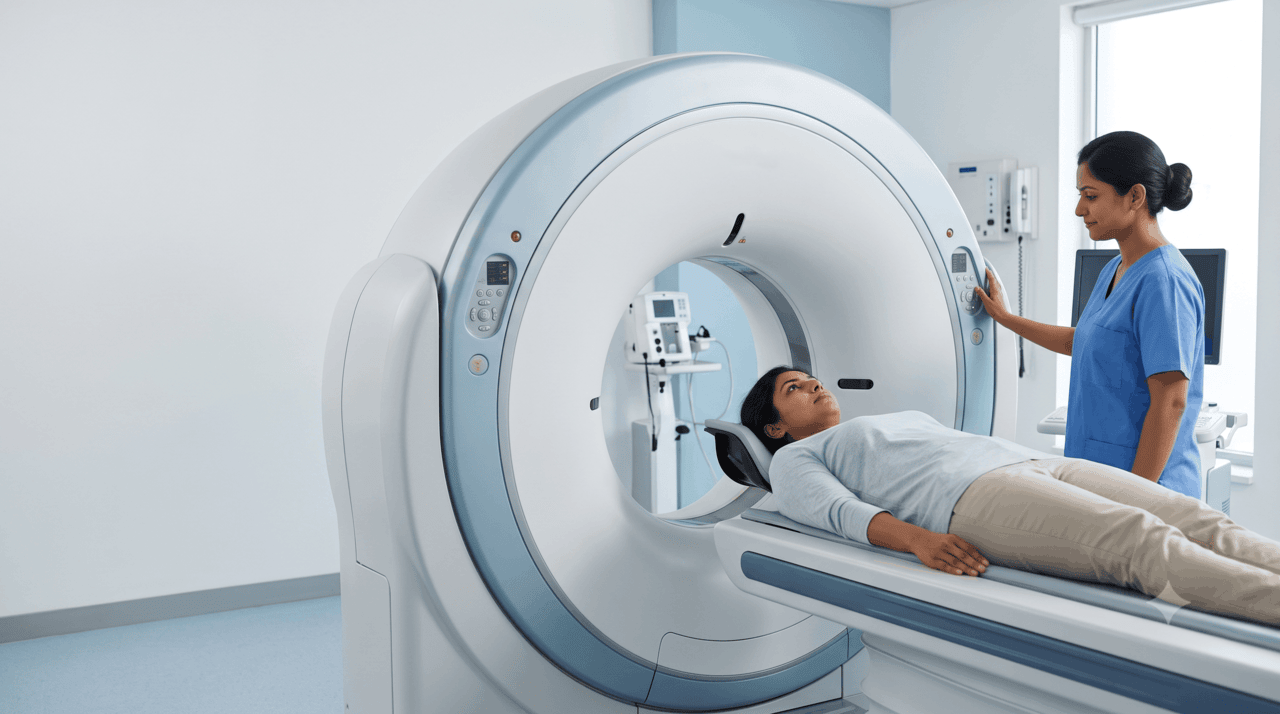
In a CT scan, the patient lies down on a special bed which is moved through the scanner. Different angles are captured to create a thorough image of the sinus area. In most cases, the scanning happens very fast, Thus, the patients have to lie still.
Also, in the case of sinusitis diagnosis, usually we perform CT of the paranasal sinuses without contrast. In some rare cases, we might use contrast- if the doctor suspects some complications, masses or other conditions.
We have to remember, that the scans use ionizing radiation and it is essential to do it only in cases needing medical attention. However, modern techniques aim at getting all necessary diagnostic information from the scan, while reducing exposure to minimum levels.
Patients must inform the medical staff if they are pregnant or think they might be, before having a CT scan.
Chronic sinus symptoms may create problems for sleep, concentration, respiration, and quality of life. Determining the cause of the issue, such as inflammation, polyps, blocked drainage, or physical anomalies, will help the doctors select the adequate treatment.
Aarna Diagnostic Centre provides CT PNS imaging as part of diagnostic evaluation when requested by a healthcare professional. The results of the scan should always be integrated with clinical signs and symptoms rather than being taken as an independent diagnosis.
The scan results can help confirm chronic sinusitis, but doctors will still depend on other symptoms and signs.
Yes. CT can demonstrate tissue changes connected to nasal polyps and the state of the sinuses.
Usually, no contrast is needed for CT used to detect chronic sinusitis.
The CT procedure is not painful, as it is non-invasive. The only requirement for the patients is to stay still.
Sure. CT provides accurate pictures of nasal and sinus anatomy which will help to find any deviations in the nasal septum and see how it changes the functioning of the sinuses.
Convenient Tests right at your Doorstep!


86, Kargi – Patel Nagar Bypass, near Palm City, Adarsh Vihar, Brahmanwala, Dehradun, Uttarakhand 248001
1, Maharani Bagh Lane, Ballupur Chowk, Ashirwad Enclave, Ballupur, Dehradun, Uttarakhand 248001
1, Chakrata Rd, near Rohan Motors, Selakui, Central Hope Town, Uttarakhand 248011
F-7, Haridwar Road Nehru Colony Dehradun, Uttarakhand 248001 India
Leave a Comment