

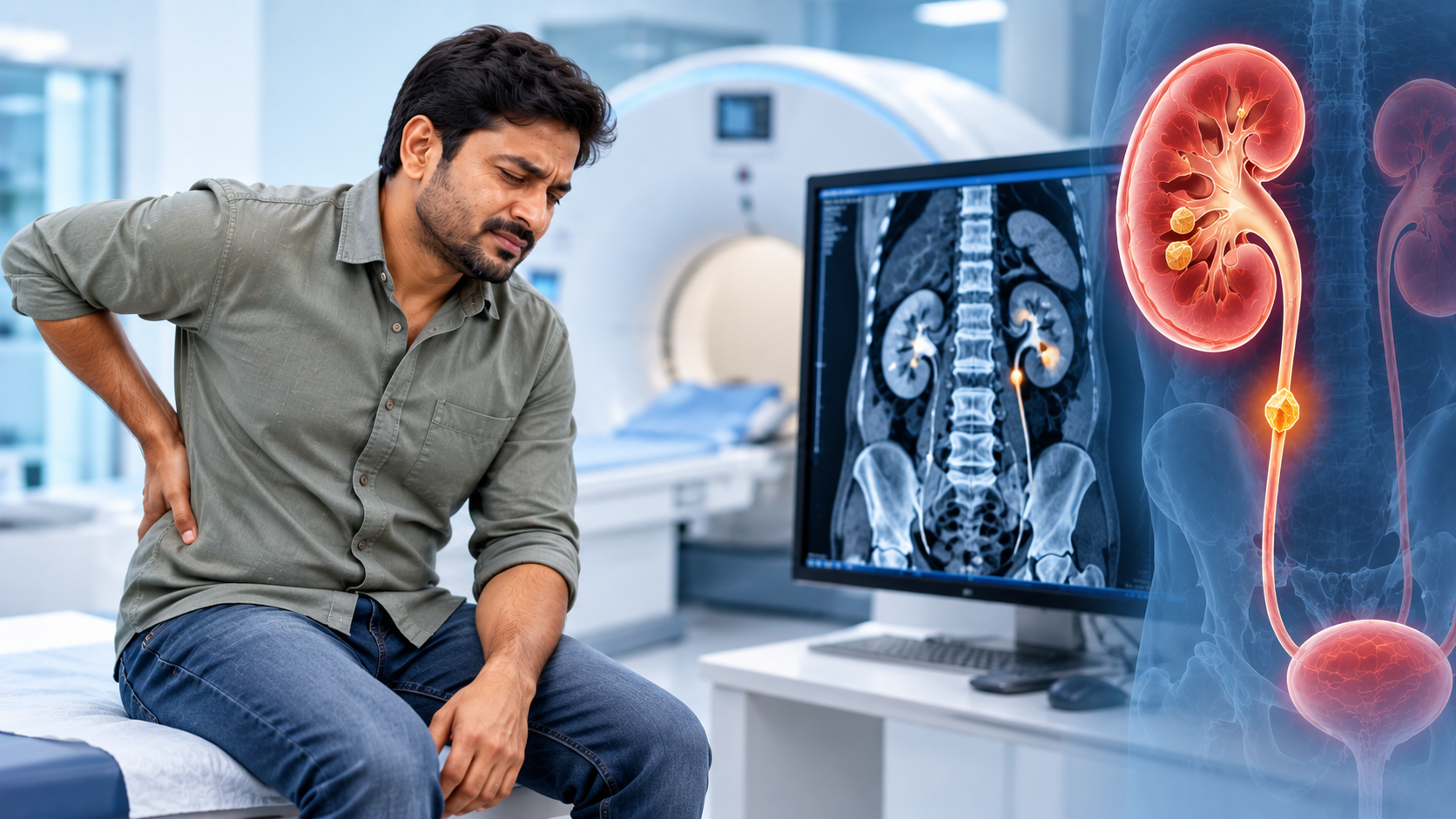
Kidney stones are solid substances that consist of minerals and salts which exist in the urinary tract. While some of them stay small enough and can be passed without any problems, others may get stuck in the urinary tract and cause extreme pain, urinary blockage, and additional complications.
When we suspect the presence of kidney stones, we may undergo CT Scan for kidney stones that help us establish the presence of the stone and its dimensions and location. One of the imaging procedures that are often used for this purpose is a CT KUB. For patients who go through a CT KUB in Dehradun, it may be useful to find out what information can be obtained through this imaging procedure.
CT KUB stands for Computed Tomography of the Kidneys, Ureters and Bladder. These structures make up much of the urinary system.
The scan utilizes X-ray technology and computer processing to generate detailed section images. Non-contrast CT KUB is frequently employed in cases where there is a suspicion of the presence of kidney or ureter stones since many urinary calculi may be visible without the need to administer any contrast agent.
However, the imaging approach depends on the clinical question, and a doctor or radiologist may recommend a different protocol when another urinary condition is suspected.
One of the main advantages of CT Scan for kidney stones is the amount of information it can provide about urinary stones.
A CT KUB can determine whether a stone is located within a kidney or has moved into a ureter. It can also show approximately where along the ureter the stone is lodged.
Location matters because it can influence symptoms and the likelihood of a stone passing naturally.
CT scans enable the measurement of the stones. Knowing the size of a stone is vital for a doctor when determining the odds of spontaneous passage and whether further treatment may be necessary.
A small stone may pass naturally, whereas larger stones are generally less likely to pass without intervention. Treatment decisions are not based on size alone.
Some people have more than one urinary stone. CT KUB can help identify stones in one or both kidneys and may reveal additional stones that are not currently producing symptoms.
A stone stuck in the ureter can obstruct urine flow. This can result in swelling of the kidney and collecting system above the blockage, a condition referred to as hydronephrosis.
CT scans can reveal evidence of blockage as well as the changes occurring in the affected kidney and ureter.
Kidney stone pain, often called renal colic, can be intense. It commonly begins in the side or back and may move towards the lower abdomen or groin.
Other possible symptoms include blood in the urine, nausea, vomiting, frequent urination, pain while urinating or a persistent urge to urinate.
Not everyone experiences typical symptoms. Imaging can therefore be important when the cause of abdominal, flank or urinary pain is uncertain.
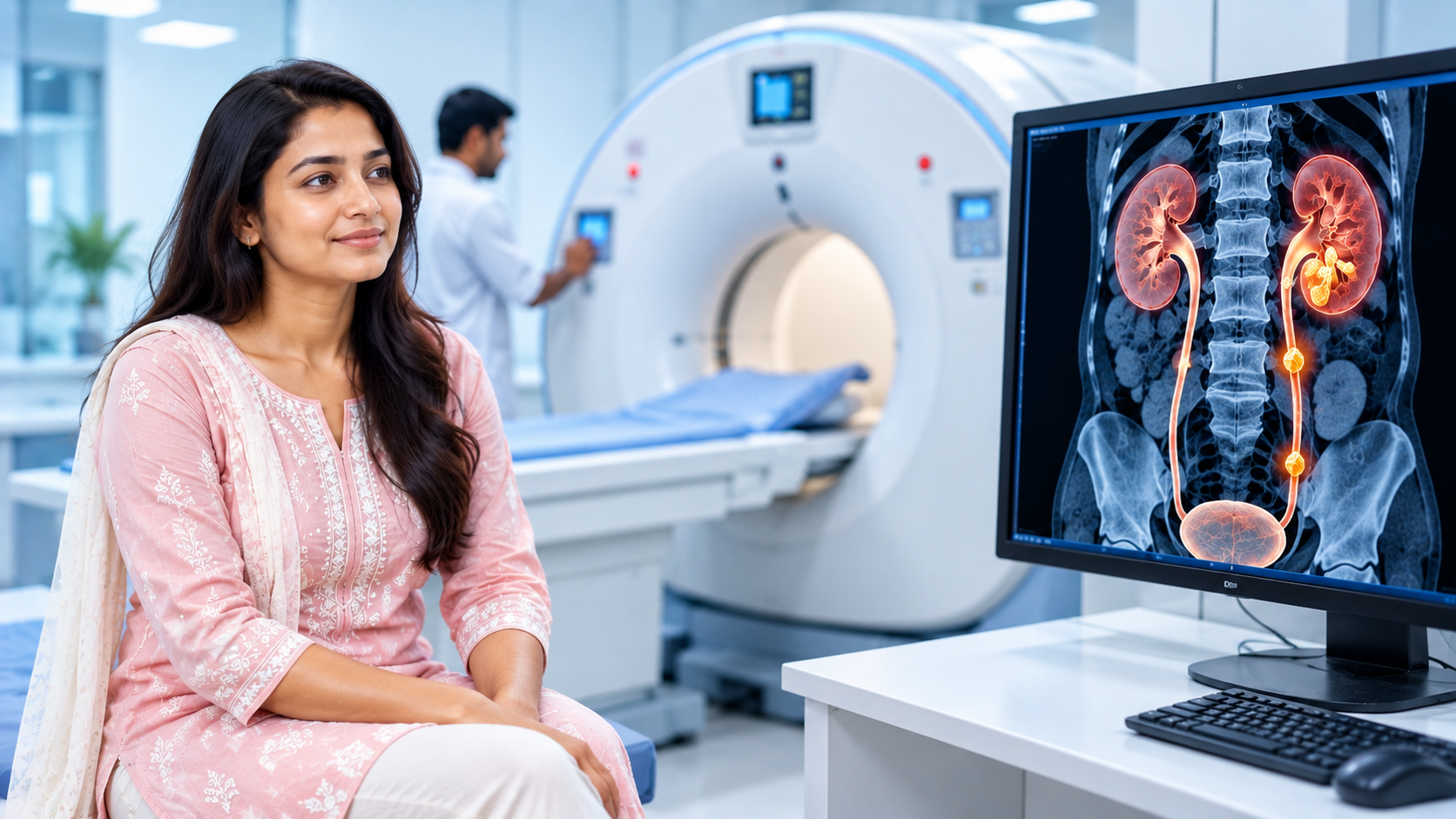
CT can detect most types of urinary stones and is highly useful for investigating suspected stone disease. However, no imaging examination should be interpreted independently of the patient’s symptoms and clinical findings.
In some situations, ultrasound may be considered instead, particularly when avoiding ionising radiation is important. The most suitable investigation depends on factors such as age, pregnancy status, previous stone history and clinical circumstances.
CT KUB is routinely done without IV contrast for simple evaluation of suspected kidney stones because stones can typically be seen directly based on their density in CT images.
However, in cases where physicians need to examine the other possible causes of the symptoms or to gather additional information regarding the urinary system, contrast-enhanced CT might be necessary; this should be performed depending on what is needed in the given clinical situation.
The preparation for imaging could differ depending on the imaging center and the protocol of the scan. Patients must take care of the instruction when they book in for the examination.
Prior to the CT scan, patients must inform the medical team if they are or might be pregnant. As CT utilizes radiation, the advantage and risk must be taken into consideration in case of performing the scan during pregnancy.
The presence of a kidney stone does not imply that surgical intervention is necessary. Treatment options are influenced by several factors, including the stone size and location along with symptoms, blockage, risk of infection and health status of the patient.
Some cases require watching the situation for improvement and treating symptoms, while others require a method of eliminating the stone.
If you experience severe pain and any of the following symptoms: high fever, difficulties with urination, continuing vomiting or feeling unwell, you must see a healthcare professional as an obstructed urinary tract infected with bacteria may require urgent treatment.
Aarna Imaging Centre offers CT services including CT KUB in Dehradun as required for diagnosis of the urinary tract.
The use of a CT KUB in Dehradun enables doctors to gather precise details regarding suspected kidney stones, such asnumber, size, and position, as well as the presence of an obstructive stone. The data acquired assists the physicians to choose the subsequent procedures in addition to examining the symptoms and other test outcomes.
CT KUB is short for Computed Tomography of the kidneys, ureters, and bladder. It is commonly performed to diagnose urinary tract abnormalities, including kidney stones.
Non-contrast CT KUB is preferred for assessing patients with suspected kidney stones. Contrast material is sometimes necessary when investigating other diseases.
Yes, CT KUB can be used to establish the size, position and number of stones and look for any signs of any obstruction in the urinary tract.
Yes, CT KUB can detect stones that have passed from the kidney to the ureter and analyze the obstruction associated with such movement.
No, CT is an imaging technique that employs X-rays to produce images rather than sound waves. The specific imaging technique will depend on the clinical circumstances encountered.
Convenient Tests right at your Doorstep!


86, Kargi – Patel Nagar Bypass, near Palm City, Adarsh Vihar, Brahmanwala, Dehradun, Uttarakhand 248001
1, Maharani Bagh Lane, Ballupur Chowk, Ashirwad Enclave, Ballupur, Dehradun, Uttarakhand 248001
1, Chakrata Rd, near Rohan Motors, Selakui, Central Hope Town, Uttarakhand 248011
F-7, Haridwar Road Nehru Colony Dehradun, Uttarakhand 248001 India
Leave a Comment