

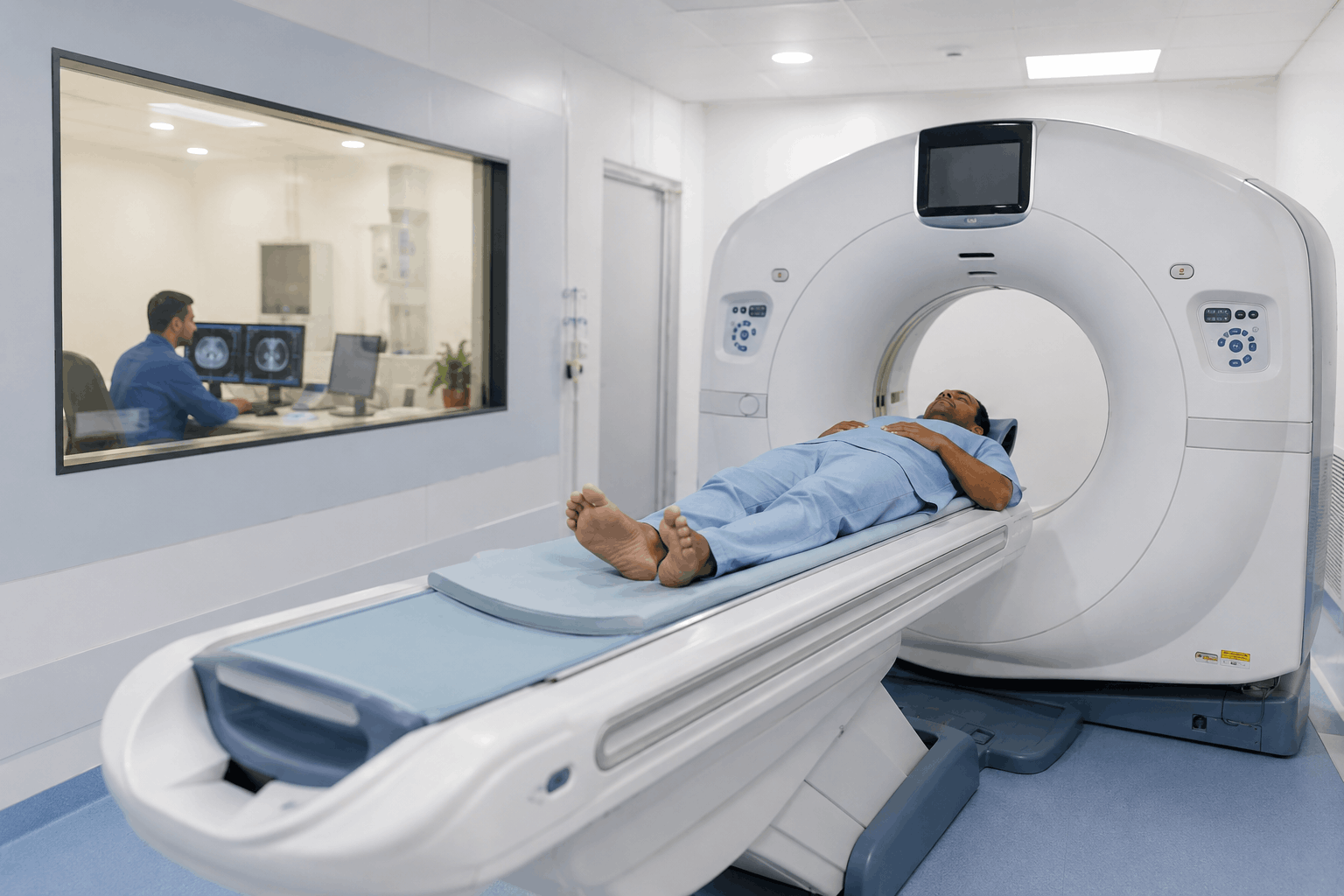
If your doctor suggested a CT scan, you might have seen or heard two terms that can sound confusing at first: CT scan with contrast and CT scan without contrast. Both types use advanced X-ray technology to form images of the inside of the body in great detail, but the use of a special contrast dye during the exam is the principal difference between the two.
This variation may seem like technical jargon to the patient, but it serves a significant role in identifying and diagnosing certain presentations. Knowing the two types of CT scans helps you generally prepare yourself for what to expect and understand why your doctor might think one type of CT scan is better than the other for your examination.
Our team at Aarna Diagnostic Centre believes that awareness enables better healthcare decisions. Their mission is to deliver precise and timely diagnostics with great patient care and innovative technology and professionals. Their focus is on preventing healthcare, working with providers, and facilitating ethics to create a healthier, more informed society.
Let’s dive deeper into the differences of CT scans with contrast and without contrast, why and when contrast is indicated, safety, and how some CT scans offer potential for more accurate diagnosis.
CT scan (Computed Tomography) is a medical imaging modality that uses a combination of X-rays and computer processing to generate cross-sectional images of the body with much depth or detail than regular X-ray images. Unlike X-rays that create flat, two-dimensional images, computed tomography captures multiple slices from angle, or views, of your body. When the CT scanners acquire the x-ray images, a computer will be used to reconstruct cross-sectional images of structures such as organs, bones, soft tissues, and blood vessels in 3D.
CT scans are very often used to detect tumours, internal injuries, infection, and diseases of the lung, liver, brain, kidneys, and many other organs.
Depending on what your doctor needs to see, you may be asked to have a CT scan with or without contrast.
A CT scan without contrast is a scan that is performed without using any dye. It simply relies on the natural differences in tissue density that X-rays can detect. This includes looking at bones, lungs, brain tissue, and some organs that have a natural contrast between densities.
Common uses of a CT scan without contrast include detecting:
Faster and simpler: Since no injection or oral dye is required, the procedure is quicker.
No allergic reaction risk: It avoids the small risk of reaction to contrast materials.
Ideal for initial screening: Doctors often use non-contrast scans as the first diagnostic step.
Useful for emergency cases: When speed is crucial, such as in trauma or head injury, non-contrast scans can be done immediately.
Limitations: Non-contrast scans may not show subtle detail of blood vessels or soft tissue because internal structures appear similar without contrast enhancement.
A CT scan with contrast uses an injectable dye (contrast agent) to help enhance image clarity. The contrast agent can be given in one of three routes:
Intravenously (IV): Injected into a vein to help highlight blood vessels and organs
Orally: Crushed and consumed before the scan to visualize the digestive tract
Rectally: Rarely given to view in detail the intestines or rectum.
The contrast agent contains iodine or barium which absorbs X-ray energy differently from surrounding tissues and can help certain structures to stand out more clearly.
This scan aids visualization of:
Blood vessels and circulation
Tumors or cancer and their spread
Inflammation or infection in organs
Vascular issues like aneurysms or blockages
Perfusion studies of the heart or brain
Detailed scans of the abdomen or pelvis
Better visualization: Contrast dye enhances visualization and aids in differentiating normal tissues from abnormal tissues
Enhanced Detection: More accurately identifies tumors, infections, and vascular abnormalities
Essential for organ assessment: Very helpful for imaging the Liver, Kidney, Pancreas, and Brain
Increased Accuracy: Increases tolerability for surgical and treatment planning since it gives the doctor a clearer “map” of involvement.
Possible allergic reactions: Mild reactions after injection (itching, some nausea, warmth).
Concerns with the kidneys: Rarely, people with kidney disease may have difficulty clearing the contrast.
Extra time: Since preparation and post-scan monitoring are required, the overall process can take longer.
In most cases, your doctor decides which type of scan suits your condition based on symptoms and medical history.
For example, a patient with head trauma may require a CT scan without contrast to check for bleeding, whereas a patient with liver disease or vascular obstruction may require a CT scan with contrast.
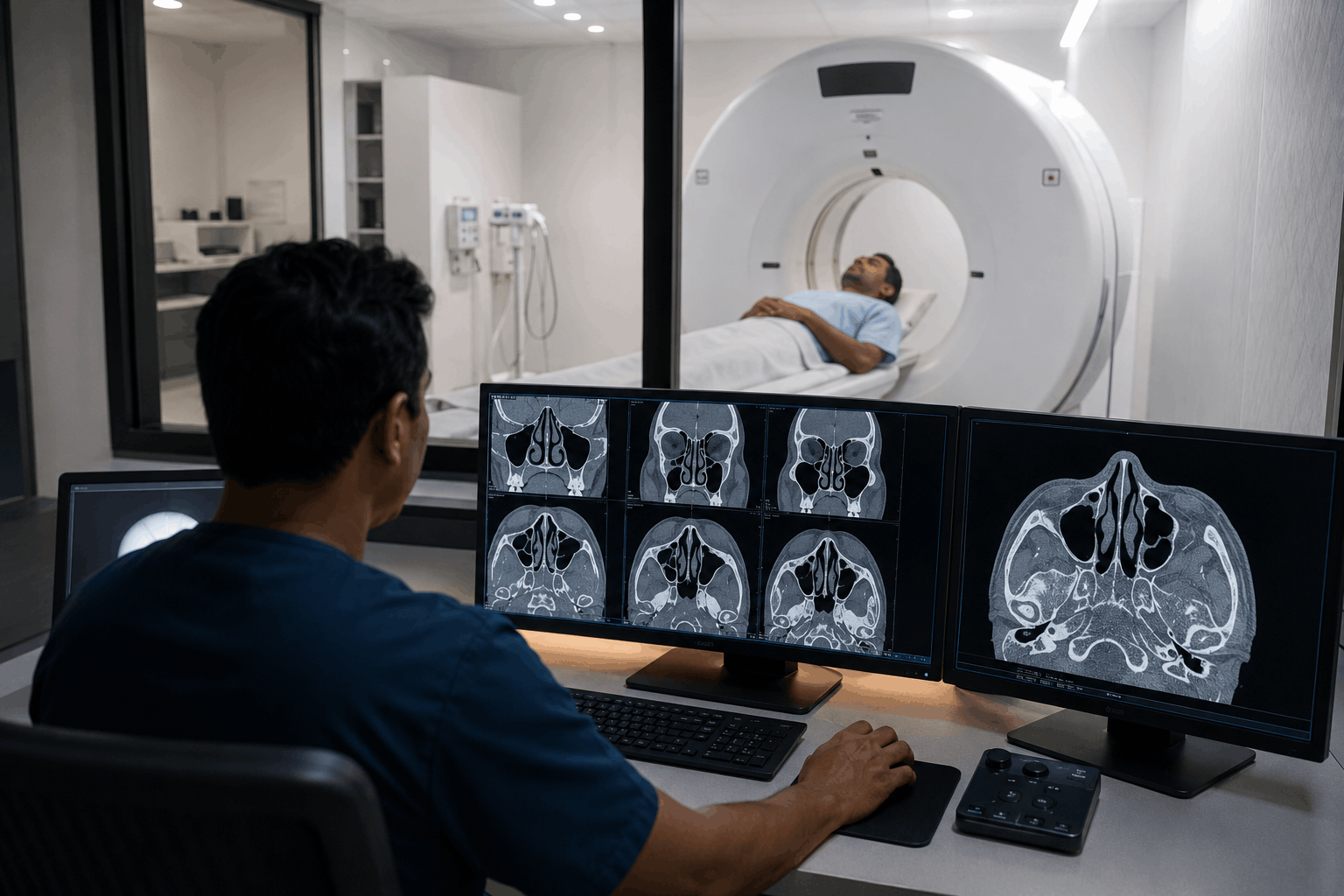
Preparation will be determined by the use of a contrast dye.
If the CT scan does not involve the use of contrast dye, little or no preparation will be necessary. You may be instructed not to eat for a few hours before the scan.
If the scan does involve the use of contrast dye, the patient is likely to be instructed to:
Not eat or drink anything four to six hours prior to the test.
Inform the doctor about allergies, asthma, or kidney issues.
Remove metal objects such as jewelry.
Drink adequate amount of water after the test to help the system flush the dye from the body.
The entire procedure usually takes 15–30 minutes, and you can resume normal activities soon afterward unless advised otherwise.
Generally, CT scans are safe, and non-invasive. The radiation exposure is minimal and accepted within medical limits. For a scan with contrast, it is natural to feel some warmth or a metallic taste, but usually is harmless. It is very rare to have a serious reaction and trained medical staff will be able to address any concerns very quickly.
Whenever you have a history of allergies, thyroid issues, or kidney disease, share this information with your doctor before your scan so anything necessary can be taken to be safe.
Choosing whether to conduct a CT scan with or without contrast is based on what your doctor needs to learn about your health. If your doctor orders:
Without contrast: the exam is ideal to evaluate bone fractures, lung diseases, and brain hemorrhages.
With contrast: this exam is ideal to see blood flow, tumors, and organ function.
It is not abnormal for doctors to order both exams to have the same images evaluated pre and post contrast.
This will ensure the very best detailed evaluation of your CT scans.

All of Aarna Diagnostic Centre CT scans are done with the latest imaging system and radiologist who are skilled in providing precise and patient safety. Every CT scan performed here is supported by advanced imaging systems and skilled radiologists who prioritize precision and patient safety.
Multi-slice CT scanners with high-speed capabilities generate high-resolution images at low doses of radiation.
The centre’s focus is preventive health, and we will only order a scan if necessary with explanation and full disclosure. Parents can expect personalized attention, fast results, and guidance on next steps. We have trained technologists who will support your child’s comfort throughout, and the radiology team will review findings using the latest standards in diagnostic findings. We always place a strong emphasis on detecting health conditions as early as possible so that we can diagnose them accurately and offer better treatment options.
The distinction between a CT scan with contrast and one without stems largely from the infusion of a dye that can help improve clarity. In essence, they are similar technologies but they serve a different purpose. Non-contrast studies are appropriate for assessing fractures, stones, bleeding, etc, while contrast-enhanced studies are appropriate for assessing soft tissues, blood vessels, and organ function.
An understanding of what each of these scans is aimed at detecting can provide more confidence for patients as they encounter their circumstances. Aarna Diagnostic Centre prides itself on its advanced imaging technology, expert radiologists, and patient focus and is a benchmark in accurate results in diagnostics and preventative care.
Whether it is a contrast-enhanced CT or a conventional CT, we perform each of these with a strong goal in mind – to provide accurate results, patient-centred care, a compassionate approach, and early answers that facilitate a healthier life.
Convenient Tests right at your Doorstep!

86, Kargi – Patel Nagar Bypass, near Palm City, Adarsh Vihar, Brahmanwala, Dehradun, Uttarakhand 248001
1, Maharani Bagh Lane, Ballupur Chowk, Ashirwad Enclave, Ballupur, Dehradun, Uttarakhand 248001
1, Chakrata Rd, near Rohan Motors, Selakui, Central Hope Town, Uttarakhand 248011
F-7, Haridwar Road Nehru Colony Dehradun, Uttarakhand 248001 India
Leave a Comment